Sunday, October 04, 2015

Something Different

I've always been partial to Singer sewing machines, mainly because they are so ubiquitous, and the older Singers are so reliable.  Most of my machines are Singers, although a couple of Brothers snuck their way into my collection, along with a couple of Kenmores and Japanese clones.

I ran across a Pfaff at a yard sale the other day, in a nice cabinet. I didn't see a price, but I knew I didn't have room for yet another cabinet in my tiny sewing room (there are three in here already). So, I passed on the Pfaff.  I remember commenting to my daughter-in-law that the Pfaff is one machine I had never dealt with at all. She just laughed, because she knows I have more than a couple of different brands of sewing machine.

So, later in the day as we are driving home from the grandkids' basketball games, she mentions that she had bought something for me at another garage sale that she went to by herself.  Turns out it is a Pfaff!  It's portable, came with all attachments and carrying case.  Checking things over, yes, the bobbin case and bobbin are there.  This machine was built in West Germany, probably sometime in the '70s.  It probably needs a good cleaning and oiling, but it sews beautifully.  I consider it to be quite a bargain at $5.00.  This is one I would not have been able to pass up myself.


Friday, August 15, 2014

Motivation and Inspiration

I belong to a quilt guild here in California. It is nice to meet with others who share my love of quilting. The quilt top pictured here was donated to our guild for the purpose of finishing it, and then to be given to a needy person. It is one of several quilt tops made by the same person. I suspect the woman who made them was deceased before they could be finished.

I have volunteered to quilt some tops for our guild's Philanthropy group, mostly to give me practice with the mid-arm quilting machine. I started out just stippling quilts, using a template to give me some guidance. This quilt top, with its plain red inner border is asking for a little something more than just an overall pattern; perhaps a vine and leaves.

Watching long-arm quilting videos on Youtube has helped me immensely in venturing  beyond meandering and stippling, into overall freehand quilting, using a couple of different designs. Some great long-arm teachers include Nicole Webb Rivera, Jamie Wallen, and APQS among others.

I have gotten very kind remarks about my quilting, and this is giving me the courage to consider quilting for others, to perhaps earn a little extra money, to help support my quilting habit.

Sunday, June 08, 2014

Stars and Stripes

A few years ago when I got serious about making quilts, one project I set for myself was to make a quilt for each of my 5 (and counting) grandchildren. I got better with each quilt, which I suppose is to be expected. The first 3 were very simple, just squares and simple shapes.

For the fourth, I saw a quilt in a magazine that I thought would be perfect. I think the pattern was called crazy daizies. Then for the 5th grand, I was stumped, so I thought about it for a long time before settling on a pattern called "Streaks of Light." I saw the pattern online and loved it, deciding to make it exactly the same colors as the original. Only one problem, I think the pattern should be called "Stars and Stripes."  I made it queen size, so it will be plenty big for years to come.  My youngest grandson will be 6 in August, and this quilt will be part of his birthday gifts. I sure hope he likes it.

So now I am on to other projects. I have a partially completed Dear Jane quilt in the drawer waiting, and a kit sitting there staring at me. Those projects will have to wait, though, because I'll be playing with a couple of grands for the next couple of weeks.

Saturday, May 24, 2014

Bionic Gear Bag

So, the other day I was reading on the Quilting Board, and someone asked about the Bionic Gear Bag. My curiosity was piqued, so I did an internet search for it, and this is what I found. After viewing the site, I just had to make one for myself. These photos are my result.

It was easy enough to cut out, and the instructions were comprehensive and easy to follow. There are four zippered pockets which are contained within the pleated sides. The zipper that closes the bag is 22 inches long and is attached to both sides of the bag, creating handy carrying loops.

For the main/outside, I just used some fabric that I had picked up at Manteca's annual quilt show boutique; when I bought it, I had no project in mind at the time, so it came in handy.  The inside coordinating fabric came out of a packet of sample fat quarters from Keepsake Quilting.

For the outside, I used extra stiff fusible interfacing. The inside, including the zippered pockets had regular medium weight fusible interfacing. For binding, I used twill tape, because stretch was not required.

This was a fun project, and it went together fairly quickly once I had assembled all the materials needed. As you can see, it holds a lot of stuff. The first pocket is shorter than the others and is great for holding smaller items such as packets of needles, machine or hand sewing . The slots between the pockets are useful for such items as scissors, rotary cutters, thread, seam rippers, even your cell phone. I think this will be handy for those times when I am sewing away from home, such as classes or other sewing group.

One thing I forgot to mention is the little fabric bowl on the right side of the lower photo. The instructions for this little bowl are available for free on Craftsy. Magnetic snaps in two of the corners attach to corresponding snaps on the first pocket and bag side help to hold the bowl in place while the bag is in use. It certainly isn't required when you are making the bag itself, but it can be handy for smaller items like bobbins or Clover wonder clips. The corner created by the bowl between the magnetic snaps creates a handy spot for items such as that purple thang, Frixion pens, or your stiletto.

I personally am using this bag for my sewing tools, but it could also be useful for electronics such as cell phones or ipods. It would hold ear phones, chargers, and styli in addition to the phone or ipod itself. It could hold art supplies such as pencils, erasers, markers, paint brushes. It could hold manicure supplies, first aid kit, nintendo games, or whatever, this bag is useful.

Thursday, September 26, 2013

Quilted Tablets

Earlier this year, we got our oldest grandson a tablet for his 11th birthday. He was thrilled with it. When he called to thank us for the gift, his little sister got on the phone. She sweetly asked if we could maybe get her a tablet when she turned 11.

So, the twins each are getting a tablet for their 10th birthday.  What can I say, I'm a sucker for the grands, all five of them.  The other two grandkids already have tablets, so these are the last two to get them.  The twins' birthday isn't until late December, so we have plenty of time to prepare.

Here are the protective covers for their tablets.  The one on the left says "Mad Scientist."  It is an embroidery file from Urban Threads. It was a freebie at one time, so I grabbed it, knowing that at least one of my grandkids would enjoy the mad scientist persona. The name on the right was created using an alphabet called "Seacrest." This font was also a freebie, but I have forgotten from whence it came. On the inside of the flap of Piper's is a design called "Imagination," from Embroidery Library.

The covers were created using leftover fabric from a wall hanging quilt that was a block of the month from Shabby Fabrics, called "My Grandma's Garden," so it seemed appropriate to create the covers for the grandkids' tablets using the leftover fabric.

Sunday, August 25, 2013

Not Your Mother's Shopping Bag

I belong to a quilt guild here in California, and our guild has a group of ladies who make quilts and other items for homeless or otherwise needy people. We also make wheelchair and walker bags, winter neck scarves, knitted hats for newborns, and more. It's a fun group of really nice ladies, and a few gents.

Recently the leader of our Philanthropy group issued a challenge to the group to decorate some reusable shopping bags that had printing on the sides. The challenge was to cover the printing, thereby decorating the bags. They will be voted on for the favorite, and I think there may be a small prize for the winner.

The bags are to be finished by October, when the voting will take place. This is my bag. The tiny ribbon bow is just being auditioned to see how it works, but I think I may have decided against it. Still, it needs something more. Someone has suggested big yellow buttons at the base of the handles, and that may be what I end up with. We'll see.

As I was working on the hexagon flowers, it reminded me of the Grandmother's Flower Garden quilt that I have been working on for a couple of months now. And I began to wonder, would this folded technique make a nice quilt? Batting could be inserted before folding, creating a quilt-as-you-go quilt. It would certainly be textured! My only concern would be to wonder if the nice neat folds would remain so when it is washed.


Monday, March 25, 2013

Sisters


I have 4 sisters; one has passed away (RIP Kellie) and the others live far away from me. The one I am closest to is 18 months younger than me. For privacy sake, I will simply call her Sis.  We get along great (now) and have similar interests, although we have very different personalities. I am the quiet, bookish one, and she is vivacious and outgoing.  When we were in school, she just couldn't get it when it came to sewing for Home Economics. Now, however, she sews a lot of her own clothes, and things for her grandchildren.

On one of my visits back home, I taught her how to make half-square triangles, and showed her different ways to arrange them for making different patterns. I could almost see the light bulb come on over her head. This started Sis to making quilts. All sorts of quilts; table runners, coasters, bed quilts, even a mantle quilt for her son for Christmas.  She sends the large quilts to me for quilting since I have the quilting machine.

So, Sis found a Block of the Month online at Shabby Fabrics.com.  For some reason, it appealed to her, so she promptly enrolled herself and me for this wall quilt. They sent the blocks to her, and she mailed mine to me every month. The final month was February, when they sent the center block, sashing, borders, binding, and finishing instructions.

Here is my center block, all finished.  Sis is jealous; she hasn't even started on her center block. She is so much in love with this quilt design that she is afraid to begin the center for fear she will mess it up. I used the freezer paper method to begin making the applique shapes. I found the freezer paper makes things much easier, particularly with odd shapes

I am currently debating about whether or not to add some simple embroidery, such as a wispy butterfly or dragonfly to mine, just to add an individualized touch. I wonder if Sis is waiting for me to offer to do her center block for her, but I think she will have greater satisfaction if she does it herself.

Quilted Dishes

Okay, I didn't really didn't try to quilt my dinnerware. I picked up a kit for making a dresden plate quilt at our local (Manteca, CA) quilt show. Some of the "petals" were already cut; actually, as I sewed the petals together, I saw that some of them had apparently been sewn and then unsewn. The precut pieces were not enough to complete a quilt, but the kit contained more, uncut fabric from which to finish the blocks.

The quilt I am currently working on uses  1930s prints. Since this is not the color palette I would normally use, it will be a challenge for me to pick background and sashing fabrics to complete the quilt.

According to this article, the Dresden Plate quilt pattern was one of the most popular quilts made during the 1920s and 30s. It was first published in the 20s but not always under the name Dresden Plate. Grandmother's Sunburst, Friendship Ring, Aster, Dahlia and Sunflower are all names used for this pattern.

I'm not in a big hurry to finish it, however, because my quilting frame is out of commission at the moment. I was quilting a quilt for our Philanthropy group last week when I noticed I was having a lot of trouble making the machine go where I wanted. If you look closely at the quilted lines, you might think I was drunk when I did the quilting, the lines are so crooked. Upon investigating the trouble, looking for obstructions or other causes for the trouble, I discovered that the rails upon which the machine carriage rides are cracked. Replacement rails have been ordered, so all should be well soon. 

Friday, February 22, 2013

Quilted Toads

The last time DH and I visited "back home," our daughter-in-law (DIL) asked me to make her a quilt. She was the only one of our 3 DILs that I haven't yet made a quilt for, so it was on my to-do list anyway. Therefore, I was more than happy to oblige.  Then she told me that she had never had anything that had been made especially for her, which made me a little sad for her. I asked her about color scheme and/or pattern preference, and she said she would love anything I came up with. She did mention pink, which is one of the colors I chose for her quilt.

This particular DIL is very fond of miniature schnauzers (she has four), so I went on a hunt for some schnauzer fabric, which I found on Spoonflower.com.  If you've ever followed Project Runway, you know they usually have one challenge where they print their own fabric, and this is one of the features offered at Spoonflower. Anyhow, the fabric was found, so now I had to find a quilt design to highlight the schnauzers so they didn't get lost in the mix.

Our local quilt guild meets on Tuesdays for group sewing on philanthropy projects. This is a generous, fun bunch of ladies who like to share. Usually there are quilt magazines available that members have brought to share, to clear out their stash. Last week I found a design in a 1995 American Patchwork and Quilting magazine that promises to be perfect for showcasing the dog fabric. The pattern, called "Toad in a Puddle" is a 100-year old pattern that was first published in the late-1800s mail-order catalog produced by Ladies Art Company. This is a picture of the main block, the "toad". (Such an unromantic name!)

The so-called alternate block is the block that will feature the schnauzers. It calls for a 9" square, which will be "framed" with contrasting fabric.  So now, I have the pattern, I have the fabric, and am almost halfway through making the "toads".  Now I look ahead to see how the alternate blocks are constructed, and the cutting instructions don't give the measurements for the frame around the 9" square. Yikes!

After panicking slightly for a while, studying the magazine for clues, and finding none, I was in a quandary. What was I to do? Then it dawned on me, I have Electric Quilt 7, which I had used to do a layout of the colors I wanted to use. EQ7 to the rescue! I was able to print out the rotary cutting guide for the alternate block, and of course it includes measurements. Another thing I like about EQ7 is the fact that it will figure and print out the quantity of each fabric needed for the quilt. There are many more features in EQ7 that I haven't discovered yet, but I will figure it all out eventually.

Friday, October 26, 2012

Feeling Like a Traitor

I've always loved the look of the old black machines from days gone by. And I truly appreciate their reliability. They were built to last, and they do. I have so many I am embarrassed to tell the number, and I love each one, although some get used more than others.

So, why am I feeling like a traitor? Last week, I attended the Machine Quilters Expo in Portland, Oregon, and took some machine quilting classes. The machines that were provided for us to use were Janome Horizon quilters edition, and I have to say, I really liked the machine. It provided 11 inches from needle to post, more room even than my old reliable Singer 15, 201, 27, and all the others. It came with a whole slew of decorative stitches and it handled all different types of threads without complaint. I used 30 wt, 40 wt, 60 wt, bobbin thread, even metallic thread and that machines just kept chugging along.

The machines used in the classes were being sold at reduced prices, and if I'd had the $$ I would have bought one. A few people in the classes DID buy one. Since I came back, I catch myself mooning over them online, checking prices, comparing features. Still, there's that nagging thought that keeps recurring, about the fact that it is a computerized machine, that surely wouldn't last as long as my old reliable cast iron models have.

Thursday, May 24, 2012

Maybe I'm Crazy

I'm one lucky gal. DH was required to visit Switzerland for a month, for business. It was one of those things where you think, please, twist my arm to make me go. Lucky for me, his company agreed to pay for my airfare to accompany him. To Switzerland!  Since it was my first trip outside North America, I had to apply for a passport, which wasn't a big deal.

Switzerland in the spring is breathtaking. There were flowers everywhere, although the mountains were still covered with snow. And the waterfalls! We saw many waterfalls created by melting snow, which in turn created crystal clear streams, rivers, and lakes.

German is the predominant language there, although some French has made it into the everyday spoken language. Being in a country where little of my native language is spoken gave me a very real sense of how immigrants must feel when they come to the United States. The Swiss are very friendly people and always willing to go the extra mile to help whenever possible. Still, not knowing the language made for interesting challenges when it came to food. More than once I ordered food at a restaurant not knowing what I would end up with. It also made grocery shopping and cooking interesting.  Who knows what measure 3 dcl is? Eventually I figured out it is 0.3 liter, which is the amount of tea you get in a restaurant. It's actually printed on the glass with a fill line. I was tempted to buy a local cookbook (if I could find one written in English) but since the measurements were all in liters and grams, my cups and teaspoons wouldn't really work.

So, because we were there for a month, we did our share of sightseeing and exploring. We went to Luzern, happening upon some sort of festival going on. We also went to the capital city of Bern, a busy city which also includes some ancient (by USA standards) architecture alongside modern buildings. On the way back from Bern one day, DH took a little detour  into the city of Thun in search of a gas station, where we discovered a real, authentic castle.  We were tired and hungry at this point, so we decided to come back to Thun another day to explore the castle/museum. The castle was built around 1190 a.d.  and contained some fascinating historical objects, such as armor, weaponry, clothing, furniture. When my oldest grandson saw the photo of me standing in front of the castle, he decided it was Disneyland and was not impressed at all!

Because DH was tied up at work most days, I had time to search for interesting things to do while we were there. I enjoy visiting thrift stores, so when I discovered one in a nearby town, we decided to visit and see what they had available. What we found was a treasure trove of things I would have loved to bring home with me, including pottery, military items, clocks, and even a couple of sewing machines. One of them in particular caught my eye: it was a Naumann hand crank sewing machine that looks very much like a Singer model 27. The price was reasonable, and I had been thinking about adding a hand crank machine to my collection, so I took a picture. Of course, DH didn't like the idea of having to deal with shipping it back to California, so we left it behind. I posted the photo on The Quilting Board, telling about the machine.  Several others encouraged me to get the machine, commenting on the beautiful decals and the fact that it is something not often seen in America.  For the next week, he teased me about visiting a country like Switzerland and wanting to get an old clunker sewing machine. The following weekend, we went back to the thrift store and brought it back to our lodging. Later he took it to arrange for shipping it back home. So far, I haven't found  much information about the machine, such as when it was built. After winding a bobbin with the hand crank, I have decided the machine definitely needs some serious cleaning and oiling before it will be useful. It also needed a needle clamp screw which was generously donated by AshleyR of The Quilting Board. Thank you Ashley!

DH thinks I'm crazy for loving these old machines, and maybe he's right. The fact remains, however, that these old machines were made to LAST, and with proper care and maintenance they will last indefinitely, continuing to sew as well as they did when new. The same cannot be said for today's computerized sewing machines.

Wednesday, February 29, 2012

Hello, my name is...

Hello, my name is Ginger, and I am a sewing-machine-aholic.  Uh, I mean, a vintage machine enthusiast. That sounds much nicer, doesn't it?  I just can't seem to help myself when I see a vintage machine. I have to look it over, see if it works, check out its attachments and appearance. Most of my acquisitions have occurred while living in California, so I shall blame it on being so far away from friends and family.

Here is my latest "rescue." It's a Singer model 15-91, built in 1934, two years before my mother was born. Obviously, the base it is in is not the original, but it needed something to sit in.

I love these old machines for several reasons. First, and most important, their reliability. These machines were precision made, all steel, and built to last for generations. If they are kept clean, oiled and lubricated, they will work like new for a hundred years or more. Most machines made today cannot make that claim.

Also, I just like their looks; their lovely decals, decorative face plates and sleek shiny surface. Another great feature is the large opening to the right of the needle. Modern machines seem to be much smaller here.  This large opening is important when it comes to making quilts, which is something I enjoy doing. These older machines will sew just about any fabric you can get under the presser foot: anything from silk to denim.

Monday, January 23, 2012

If It Quacks Like a Duck

As I mentioned last time, our Cara Cara orange tree turned out not to be oranges.  So now we have mystery fruit.  The fruit is large, yellow, and the rind is nearly an inch thick. It looks and tastes like an overgrown lemon. Could it be a Ponderosa lemon tree? At first, we thought it might be a pomelo, but most of the information we could find claims that pomelos are sweet.  So, do we have a ponderosa lemon or pomelo tree? We may never know for sure. At right is a picture of our first harvest.

Probably the biggest drawback to this tree is the fact that it will get huge, and has enormous thorns. The other day when I picked them, I ended up with scarred up hands. Guess I should have worn some leather gloves. I'll remember that next time. This was a particular problem when it came time to begin juicing the fruit, because the juice stung every scratch or prick on my hands. Eventually I remembered the cleaning gloves I had bought at the Dollar Tree. They saved the day, and my hands. With some help from my strapping 6'-3" stepson, so far we have frozen about a gallon of juice. 
The cake stuck to the pan,
but it still tastes great!


I have used the juice and zest in recipes as if they were lemon. It tastes just like lemon to me, and the meringue pie and "lemon" pound cake both tasted exactly like lemon.

Now I need to find lots of recipes to use up all this lemony goodness. It surely has lots of vitamin C and other good stuff, so why not?  I can't continue making pies and cakes and other goodies; all of us need to lose some poundage and sweets are counterproductive.

Friday, January 06, 2012

When Life Gives You Lemons

One of my own favorite sayings is "bloom where you're planted."  I try to live by that, even though I've been transplanted a time or two. The latest transplanting took place nearly four years ago when my husband accepted a job in California. The weather here is lovely; there are none of the extremes we experienced in Tulsa, such as ice storms, hail storms, tornadoes, extreme summer heat and humidity. It does get hot here, but with lower humidity it doesn't seem so bad. Our house seems to do a great job of staying cool too.

One of the first things we wanted to do when we moved was to plant some fruit trees. First we planted a Cara Cara orange tree and a Key Lime tree. Next came the cherry tree, which apparently has grafts of several different varieties of cherries. All of these trees are self-pollinating, which means we don't need two of each to get fruit.

After three years, the orange tree was the only one to bloom, but when it did, it was covered with blossoms. We waited excitedly all summer, watching our baby oranges grow. And wow, did they grow! They got huge!  Now they are ripe, ready for harvesting, but something isn't right. They're about the size of a large grapefruit, yellow, and roughly pear-shaped. The nursery where we bought the tree was surprised, and could not identify the type of fruit, but agreed that it definitely was not a Cara Cara orange.

Now for a taste test.  After peeling away about one and a half inches of rind, I got to the juicy, yellow center, which contains lots of seeds. The sections are separated by a very tough membrane which isn't easily pulled away. It tastes a lot like lemon, very tart.

 I included an orange in the photo for comparison. It looks like the tree we have is a pomelo.  Guess I could make some lemonade. Or would that be pomelade?

Wednesday, November 16, 2011

Quilted Football

Thanksgiving is right around the corner, and we're making plans to visit the family back in Tulsa. I saw this pattern the other day, and thought it would be just the thing for my youngest grandson, who is 3 years old. Because quilting is my thing these days, I decided to make it quite scrappy instead of color coordinating, or attempting to make it look "real."  The pattern came from Jinny Beyer Studio (http://www.jinnybeyer.com). It's a .pdf file, easily printed at home. 

Because the printed pattern has some overlapping pieces, I printed it on regular paper, then traced the pieces onto the dull side of freezer paper. After cutting out the freezer paper pattern pieces, I ironed the freezer paper, shiny side down, onto fabric. This is a great way to be precise when cutting out irregular pieces like this, and the paper is easily removed without damaging the fabric. Freezer paper pattern pieces can also be used again several times. Can you tell I love my freezer paper?

I strayed a little bit from the instructions that came with the pattern. I used fiberfill instead of 100% cotton stuffing. I thought the cotton might make it too heavy and firm for a 3-year old. It turned out firm enough for throwing, yet still soft enough to use as a pillow while watching TV.

Tuesday, July 05, 2011

Sewing Machines

Some people just don't understand.  Years ago, I fell in love with the look of the old treadle sewing machines. Yes, that's right, the old style black machines. So I decided I wanted a treadle machine. I already had a perfectly good Kenmore zigzag machine that I had bought new in the late 70s, but I wanted a nicer cabinet for it. When an estate auction put an old sewing machine in a nice wood cabinet up for sale, I bought it for $20. I was the only bidder, probably because it didn't have the electric cord or foot pedal. It turned out that my Kenmore machine wouldn't fit into the singer cabinet.

So, I took my "new" old black machine to a Singer repair center to see about getting the cord and foot pedal. This was a mistake. They charged me more than triple what I had paid for the machine. Then I discovered it wouldn't sew. Everything seemed to work, but it wouldn't make a stitch, so my auction bargain became extra space to hold my sewing things, and the machine never saw the light of day.

A few years later, I found a user's manual for the machine, which turned out to be a Singer 201, from 1939. After reading the manual, I discovered that I had been threading the needle in the wrong direction. Once I threaded the needle correctly, the machine began sewing beautiful straight stitches. In researching this machine, I learned that it was considered to be one of Singer's all time best machines! And to think it had been sitting unused for so long. Today, it is my favorite go-to machine for everyday stitching. These days it is mostly sewing together quilt tops.

Since discovering what a jewel I had, I was apparently bitten by the vintage sewing machine bug. I finally got not one, but two treadle sewing machines, both of which are in good working order. I still have my original Kenmore, although it has been promised to my son. My mother's White zigzag machine from the late 60s came home with me after her funeral, and it still works fine too. I have another White machine which was originally a treadle, but converted to electric, and is in the process of being cleaned and refurbished.

The other day, my sister sent me an email with a picture of a Singer featherweight she had just bought from Ebay.  Because she thought her Singer 185k was tiny, she couldn't believe that the featherweight was even smaller. To convince her of just how small the Featherweight is, I sent her a picture of 3 of my machines. The Featherweight is in the front, back left is a repainted Singer 99, and back right is my old faithful Singer 201. Something tells me that Sis has also been bitten by the vintage sewing machine bug. She has told me that her little green Singer 185k is her favorite.

Saturday, April 16, 2011

Why You NEED That 4th Rail

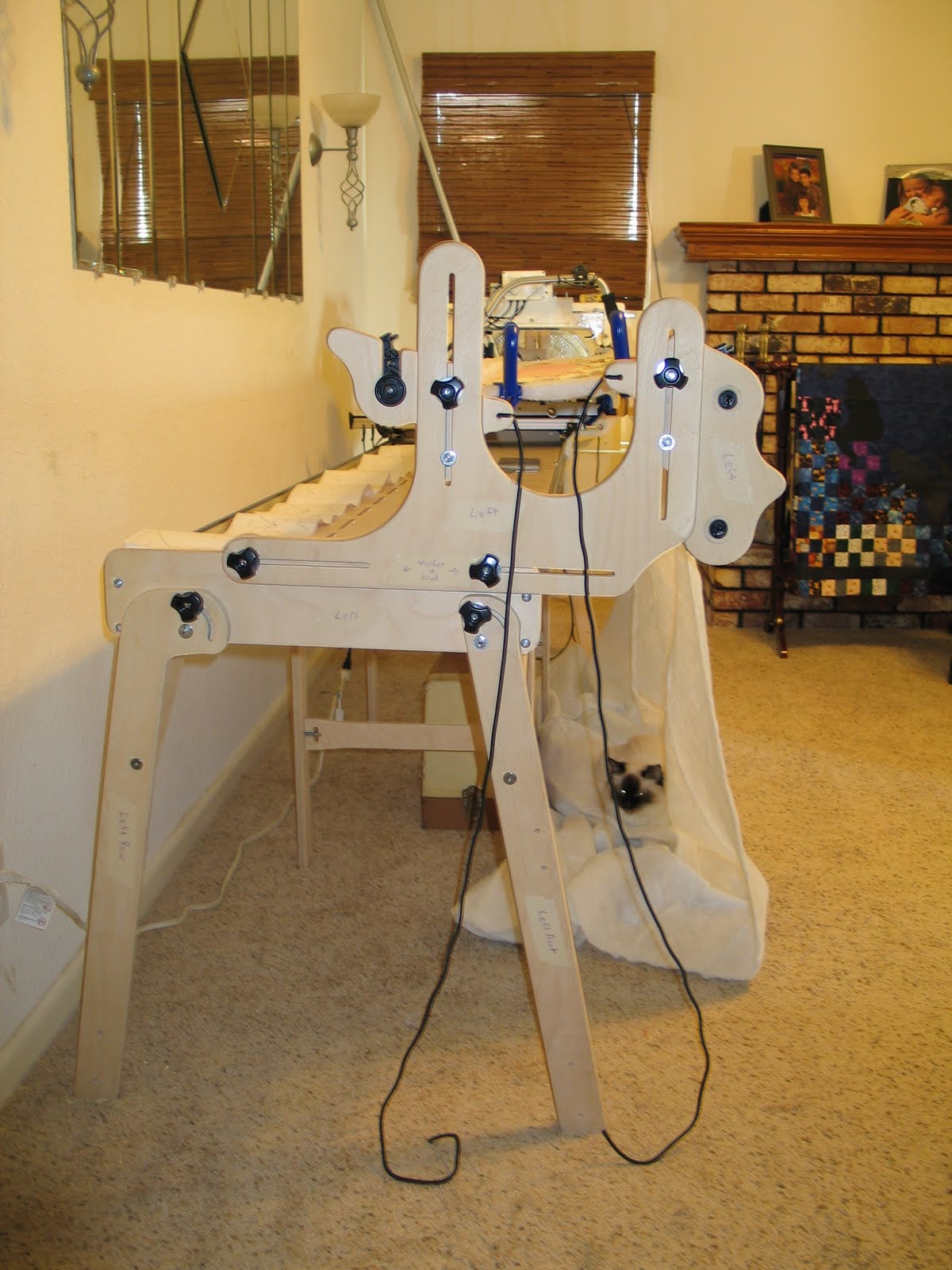
I got a Bailey midarm quilting machine recently. I was up in Washington visiting with DS, DIL, and DGKs for Spring Break, so my DH drove to pick it up for me. He had it all assembled when I got back, and he did a great job.  Except, he didn't install the fourth rail. The assembly instructions didn't mention the fourth rail, and he didn't know what it was for anyhow. I tried to install it this morning, but didn't have the right nuts and bolts.

Today, I finally got around to loading up the backing, front, and batting for a quilt. I got the top at a yard sale, and I figured since I didn't have much work or attachment to it, that top would be a good one to practice on. If it turns out really bad, I'm sure the dog won't mind sleeping on it. Anyhow, because the fourth rail wasn't installed, the extra batting just sort of hangs there (floats is the quilting term) attached at the top but not at the bottom. So, we went to the local home improvement store to get the nuts and bolts, along with stuff for the vegetable garden. And wouldn't you know, we forgot the nuts and bolts.

We came home and went right to work outside in the garden. I came in to get a drink and cool off (don't forget, I'm in SUNNY California) and discovered a very good reason for having that fourth rail on the machine quilting frame. This is Bobbie, who thinks she has found the perfect hidey-hole.

Thursday, March 31, 2011

Future Quilt

Last year, I decided to make each of my grandchildren (five and counting) a quilt of their own. Four are done and I am still thinking about what to do for the fifth. I posted photos of these quilts on my facebook page. A friend of mine saw the photos and decided she had to had one too. This is the one she picked. What followed was a discussion about what type of quilting she wanted, and she chose to have it be tied instead of paying a long-arm machine quilter. Of course, I had to remind her that Butch the dog doesn't go with the quilt.

I also told her that she had to wait; I already had other quilts in the queue that needed to be finished before I could begin to work on hers. Well, those other quilts are finished now.

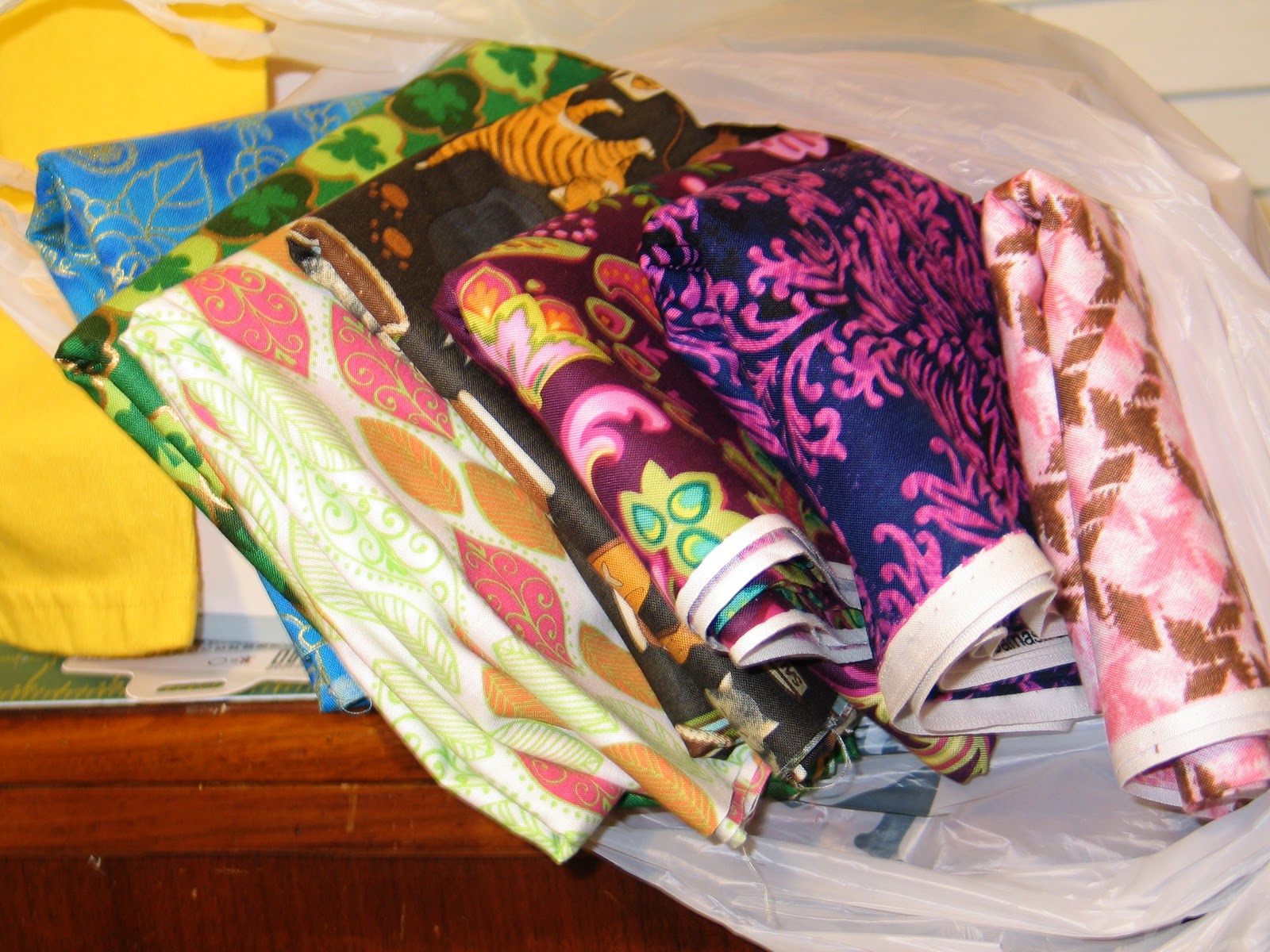
So while I am anxiously awaiting the arrival of my new quilting machine, I went shopping. I decided to go ahead and get the fabric for Lyn's quilt, even though I won't be able to work on it for at least a week.  Why, you ask? I get to spend Spring Break with three of the grands!  Anyhow, this is what a future quilt looks like.

Monday, March 28, 2011

Starting to Get Excited

My car broke down the other day, just refuses to start. We had to have it towed home. DH has tried to fix it, but can't seem to find the problem. So now he intends to take it to the dealership to have it worked on.  The car is old, and was wrecked last year, although the damage was fixed.  DH has been talking about getting another car, but we have no idea where the $$ would come from.
The other day, I was casually opening the mail, when I got a big surprise: an unexpected check made out to me.  $$ that is not earmarked in the budget! :D So now, we'll be able to fix the car. And get a used second car so I won't be without transportation on days when DH can't ride his bike to work. AND get that long arm quilting machine I've been wanting. :D
There will be a learning curve, no doubt. I've done some FMQ on my vintage Singers and managed to get passable but by no means professional results. One of the problems with vintage Singers is the limited amount of space between the needle and back of the sewing area. This new machine will give me twice as much room to work in and it comes complete with a Grace quilting frame, metal rods (as opposed to wooden ones, which have a larger diameter), laser stylus and quilting patterns, complete instructions, and a Stitch Regulator!
I can't wait to get my hands on this puppy. Unfortunately, I'll be out of town next week, so I won't be able to play with it until I get back. That's okay, though, because I'll be playing with three of the grandkids all week. :D:D:D

Friday, March 18, 2011

FMQ

In quilting terms, FMQ means free motion quilting.  It can be done either on a long arm quilting setup, or on your regular old sewing machine. Since I don't have a long arm quilting setup, I'm using my new-to-me but 90-year-old "Red Head" Singer, model 66, while crossing my fingers hoping that there is a long-arm machine somewhere out there with my name on it. This is a straight stitch only machine, without reverse. Which means no backstitching. When you FMQ, it is necessary to either lower or cover the feed dogs, so they don't interfere with the free movement of the fabric under the needle. This machine didn't come with a feed dog cover, and the feed dogs don't lower. So now the feed dogs are in the drawer of the lovely old cabinet she sits in.
I've begun working on DDIL's t-shirt quilt, the actual quilting (FMQ) of it. Believe it or not, marking the quilting lines takes longer than actually sewing them.